Grace Yang
Back to projectsCase study

01 / Work · Shanghai Disney UX Research Library

AI-assisted internal product · 0→1

Turning research into action.

As my team’s first dedicated UX researcher, I built and tested an insight repository that made past evidence easier to find, understand, and bring back into product decisions.

Explore the demo All content in the demo is placeholder data
My role
Researcher, product owner, designer + AI prototype builder
Timeline
1-day MVP · 3 months of iteration to launch
Team
Solo product lead · partnered with engineers on the database
Methods
Workflow analysis · task evaluation · usability testing
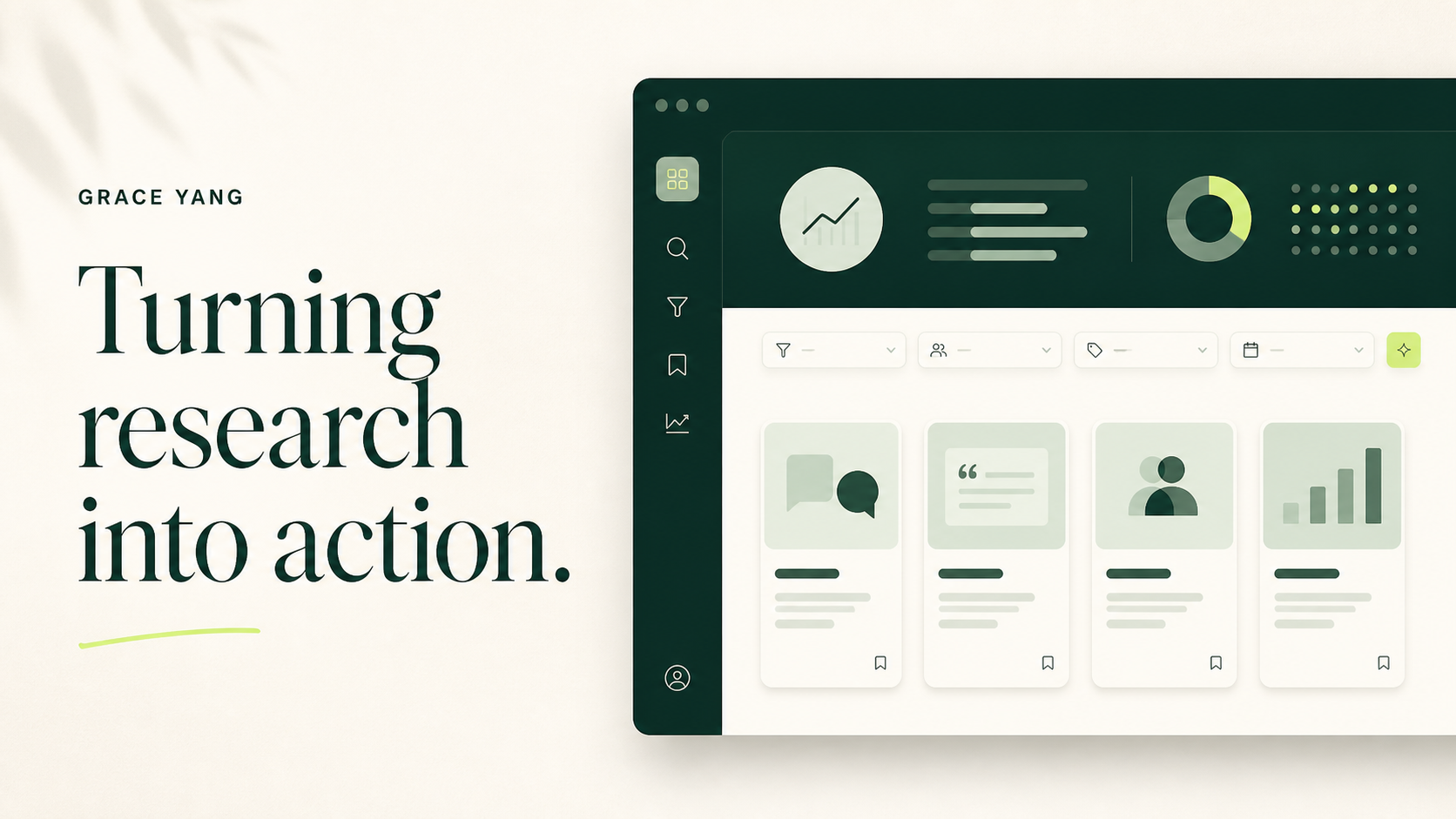
Grace Yang, Turning research into action, with an editorial insight repository interface
Shanghai Disney UX Research Library · Company research remains confidential
1 dayfrom PRD to working AI-assisted MVP · then 3 months of iteration to launch
6designers and PMs in task-based evaluation
5real research projects catalogued in 3 months
~10 mindirectional retrieval signal, down from a recalled day+

02 / The challenge

Research created conversation—but not lasting momentum.

Readouts generated curiosity and meaningful discussion. After the meeting, however, findings disappeared into decks, notes, and video clips. What resurfaced depended on memory, convenience, or which insight happened to attract a leader’s attention.

New teammates

Could not independently learn what we knew.

There was no reliable starting point for understanding users or past studies.

Designers + PMs

Asked me to reconstruct the evidence.

I searched old decks, notes, and clips whenever a product area returned.

The research function

Risked repeating work—and losing influence.

When evidence was difficult to retrieve, it was less likely to shape a decision.

The strategic risk

Hard to findUsed lessUser voice weakenedImpact appeared limited

03 / Choosing the right problem

I looked past the storage symptom.

A better archive was the obvious solution. But storage alone would not change decisions. I traced repeated requests and post-readout drop-off to a deeper gap: teammates could not retrieve evidence, understand its context, or see what it changed without the researcher.

What I observedRepeated requests, fragmented artifacts, researcher dependency
What it meantThe constraint was evidence reuse—not file storage
What to design forRetrieval, comprehension, and visible follow-through
Reframed opportunityHow might we make user evidence easy to retrieve, interpret, and reconnect to product decisions?

Scope tradeoff

One product could not solve every maturity gap.

Early conversations surfaced two needs: research literacy and research retrieval. Combining them would make the repository broader and harder to navigate. I moved education into a separate UXR wiki and protected the repository’s core purpose.

01Capture

Keep a study, its evidence, and its context together.

02Discover

Find prior research without depending on the researcher.

03Activate

Make the path from evidence to follow-up visible.

04 / From PRD to product

I used AI to close a resourcing gap.

Enterprise repository tools were outside our budget or required lengthy procurement, and dedicated engineering capacity was not available for an unproven concept. I wrote the PRD and used Codex and Cursor to build a working AI-assisted MVP in one day. Over the next three months, I tested and iterated the workflow with designers and PMs while partnering with engineers on the database for launch.

AI accelerated

1-day MVP

From PRD to a working AI-assisted MVP in one day—fast enough to put a concrete product in front of users.

I owned

Product judgment

Problem framing, scope, information architecture, interaction decisions, testing, and iteration.

Engineering partnership

Durable infrastructure

Over the following three months, I partnered with engineers to build the database, refine the workflow, and prepare the product for launch.

01Upload

Capture a study and its evidence.

02Browse

Search and filter past insights.

03Follow up

Assign an owner and view status.

04See progress

Give leaders a portfolio-level view.

05 / The turning point

Testing proved my organizing model was wrong.

I tested two realistic retrieval tasks with three designers and three PMs. The atomic-insight model was precise, but participants began broadly—with a product area or remembered project—then narrowed toward a finding.

6participants

Learn about an unfamiliar product area Revisit a familiar area to inform prioritization

V1 / InsightsDemo data
Before · Insight-firstFindings appeared without enough study context.
V2 / ProjectsDemo data
After · Project-firstProjects established context before individual findings.

What testing revealed

Findability is not comprehension. Evidence becomes reusable only when people understand the context behind it.

The product tradeoff

Conceptual purity or responsible reuse?

I changed the primary browsing unit from an atomic insight to a research project. Background, timing, participant context, and business context now frame the evidence. Atomic insights remain nested and actionable, while stable filters coexist with flexible, project-specific tags.

I traded some precision at the entry point for comprehension, trust, and safer application of evidence.

06 / Designing for influence

From tracking activity to showing impact.

Designers and PMs needed evidence they could reuse. Leaders needed a credible view of what that evidence had changed. The first dashboard showed coverage and progress, but not the value behind the activity.

Demo contentCompany research, taxonomy, participants, and decisions are confidential.

Leadership viewResearch impact
Last 90 days
New in iterationRecent Wins
View all

Research clarified the priorityDecision influenced · Demo project

Strategy

Evidence changed the concept directionDesign iteration · Demo project

Product

A past insight prevented duplicate workEvidence reused · Demo project

Efficiency
Recent Wins made research outcomes visible to leaders—not only research activity.

Workflow tradeoff

Visibility without another system to maintain.

I kept action tracking lightweight rather than competing with the team’s established delivery workflow. The repository shows that evidence entered evaluation or delivery without becoming a second project-management source of truth.

Designed to reinforce a positive loop

  1. 01Impact made visible
  2. 02Confidence in research grows
  3. 03Teams engage research earlier
  4. 04More opportunities for impact

07 / Early impact

Evidence began moving without me.

The pilot did not prove full organizational UX maturity. It showed meaningful movement: research was easier to retrieve, easier to interpret, and more likely to re-enter product conversations.

5

Real projects catalogued

Built into a usable knowledge base across the three-month pilot.

~10 min

Directional retrieval signal

Compared with a recalled day or more in the previous researcher-dependent process.

1

Strategic decision informed

Resurfaced research contributed to a confidential prioritization decision.

↑

Leadership appreciation

The director approved the pilot, encouraged adoption, and championed it across teams.

Evidence note: The retrieval comparison is directional, not a controlled benchmark. The previous duration was recalled; the repository task was estimated during observation. No visit or repeat-user count is claimed because analytics were not available.

What I learned

Storage was never the real constraint.

Practitioners need contextual evidence they can reuse. Leaders need a visible record of what that evidence changed. The strongest product decision was recognizing that my first model was wrong—and rebuilding the product around how people seek, trust, and value research.

AI made the experiment possible in a day. Research made it useful.

08 / Final product

One system for evidence, action, and impact.

The final repository supports the full research lifecycle: teams can locate relevant evidence, understand the project behind it, add new insights, and see what happens next.

Demo contentCompany research, taxonomy, participants, and decisions are confidential.

Explore the interactive demo
Demo repository with keyword search, domain filter, signal filter, and research project cardsDemo data
01

Browse by domain and keyword

Search across projects, insights, quotes, and tags, then narrow the library by domain or research signal.

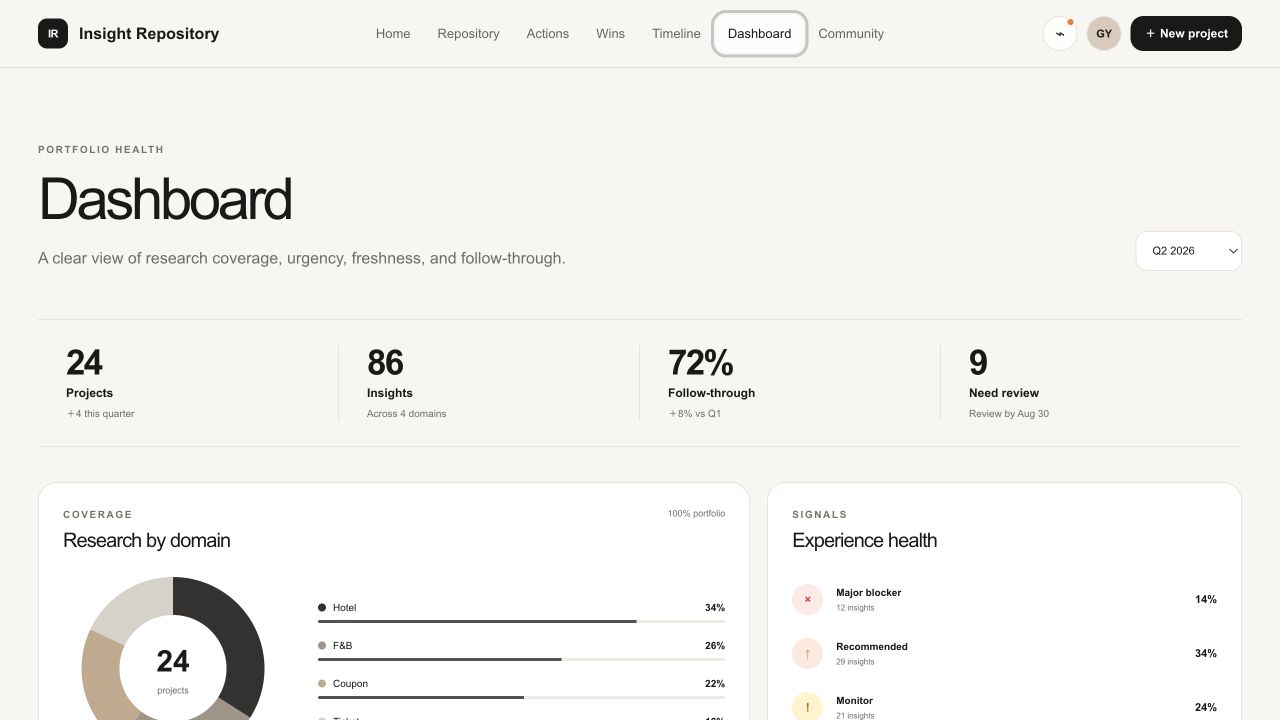
Demo leadership dashboard showing research projects, insights, follow-through, review needs, and domain coverageDemo data
02

See the research portfolio

A leadership view documents projects, coverage, urgency, freshness, and follow-through across the portfolio.

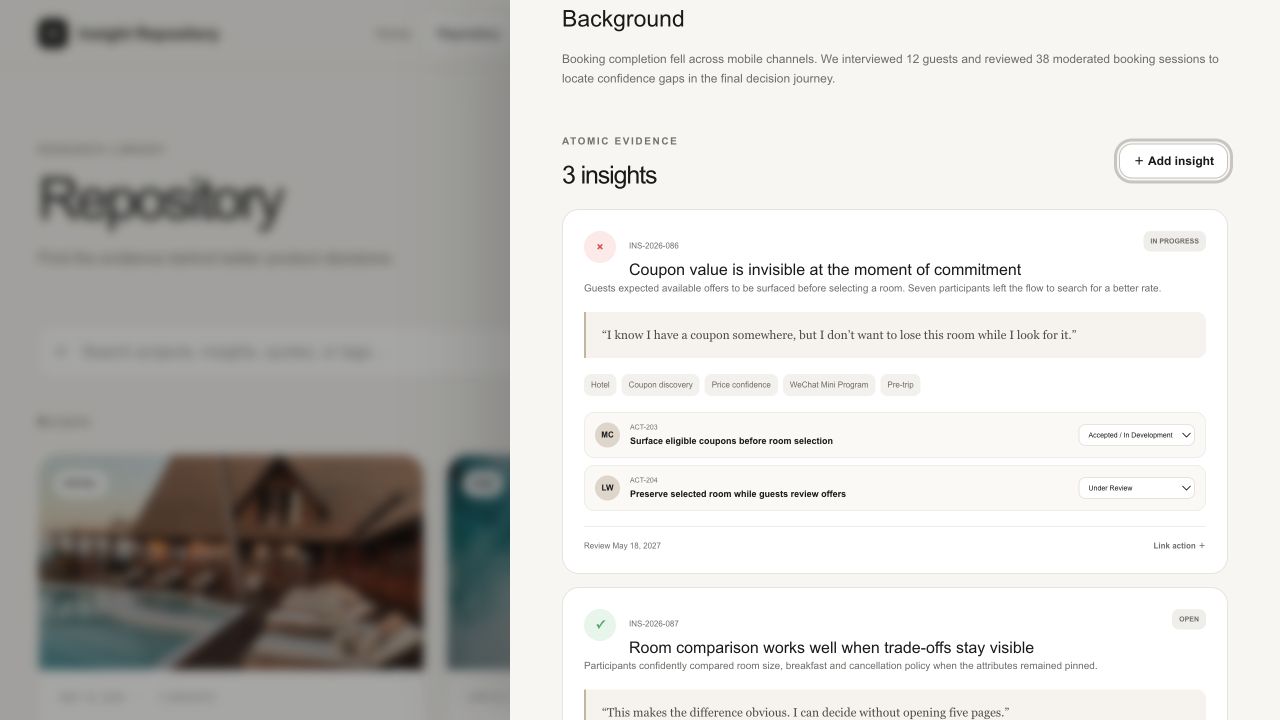
Demo project detail with an Add insight control and atomic insights stored in project contextDemo data
03

Upload insights in context

Add atomic evidence inside its originating project so findings retain the background needed for responsible reuse.

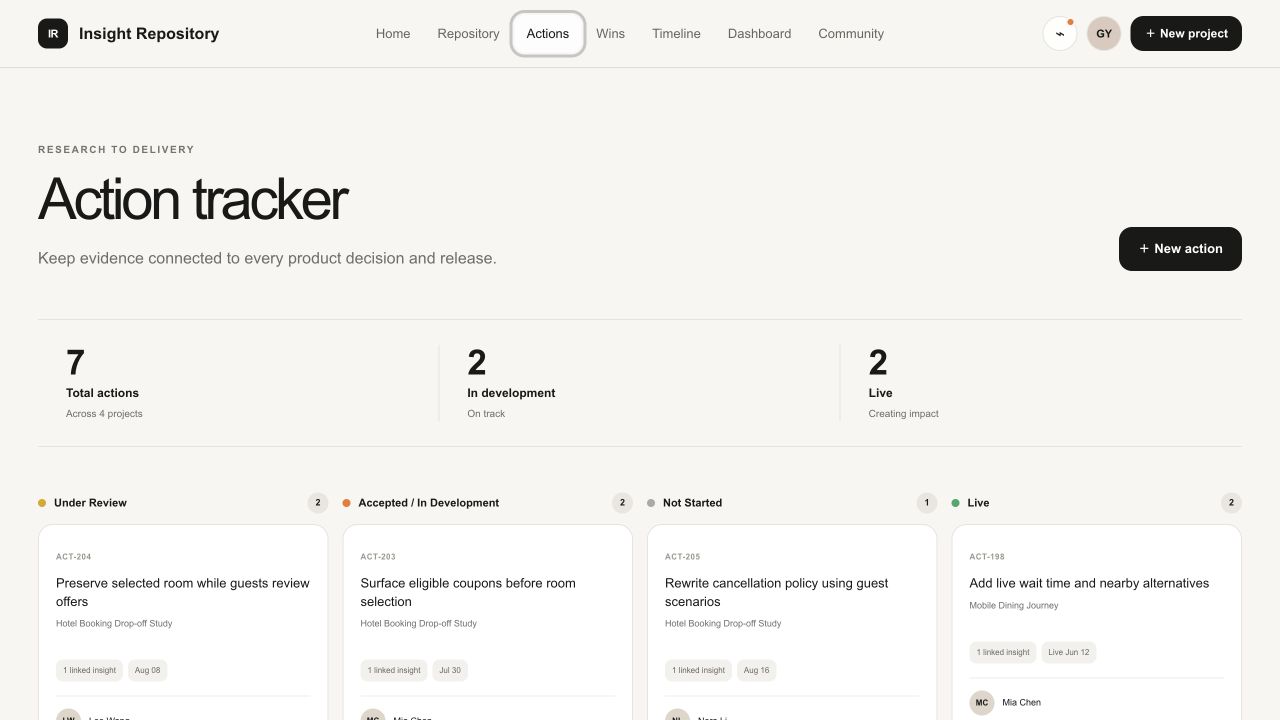
Demo action tracker organizing linked research actions by review, development, not started, and live statusDemo data
04

Track action without replacing delivery

Keep owners and status connected to the evidence while the team’s established delivery tools remain the source of truth.