Grace Yang
Back to projectsCase study

02 / Work · Tailor Talk

AI-assisted learning platform · Functional prototype

From showing up to wanting to know more.

Tailor Talk began with a recurring tension from my work as an academic tutor. Traditional classes often have to be completed whether or not personal motivation has formed, while keeping each lesson personally relevant requires fresh preparation from the teacher. I built a functional prototype to explore how student choice, teacher judgment, and AI-supported practice could create more room for curiosity.

My role
Academic tutor · product strategy · UX design · prototype build
Product stage
End-to-end functional prototype · validation planned
Intended users
Students in recurring guided classes · the teachers preparing them
Current evidence
Tutoring observations · product impact not yet validated
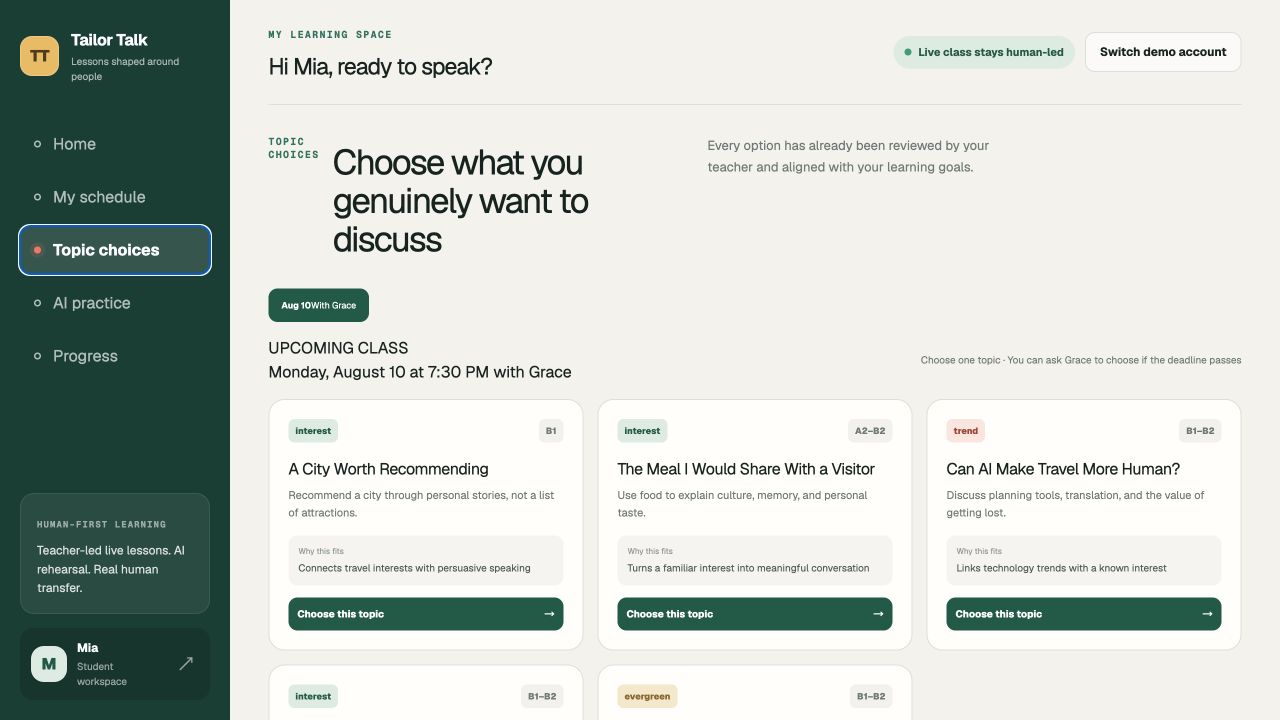
Tailor Talk topic choice screen showing teacher-reviewed topics connected to a student's interests
Functional prototype · All names, schedules, and lesson content are seeded demo data.
SoloProduct judgment, UX, and prototype ownership
2 rolesOne experience designed for students and teachers
CurrentFunctional prototype grounded in tutoring experience
NextValidate the learning loop before investing in scale

02 / The origin

Completion and curiosity are different signals.

My students were attentive and conscientious. The issue was never whether they liked the class or completed the work. Traditional learning can function without asking what a student genuinely wants to explore, so I looked for a way to make personal curiosity part of the learning process.

Teacher constraint

Personalization repeated the preparation work.

Finding a timely topic, prompting ChatGPT, and editing a one-hour outline still had to happen before every class.

Student context

Required participation does not guarantee personal motivation.

Students may complete a class because it is expected, even before genuine curiosity about the subject has formed.

Product opportunity

Relevance had to become repeatable.

The student needed a meaningful way into the lesson. The teacher needed a faster way to prepare something worth teaching.

The shift Tailor Talk is designed to support

Class is requiredChoice creates relevanceCuriosity has room to form

03 / Product framing

I started from a different motivation problem.

Many self-directed learning platforms serve people who arrive with an existing goal, whether that comes from interest in a subject, career progress, or the value of a credential. Tailor Talk starts earlier, with students who need to attend class whether or not that motivation has formed yet.

Self-directed platformsMotivation already exists
Traditional classesAttendance may come first
Tailor TalkHelps curiosity take shape
The product question

How might a required class make room for genuine curiosity, while helping the teacher prepare relevant material more sustainably?

04 / MVP priority

I prioritized the complete learning loop.

My first brainstorm included trend integrations, multi-teacher operations, detailed analytics, and model evaluation. I chose the smallest end-to-end journey that could test whether the core experience made sense before building its infrastructure.

01 · StudentChoose

Select a topic that feels relevant.

02 · AIDraft

Turn that direction into a possible lesson.

03 · TeacherReview

Edit the draft and decide what is worth teaching.

04 · TogetherLearn

Use the approved lesson in a live class.

05 · AIRehearse

Practice in a bounded, low-pressure setting.

06 · StudentTransfer

Use the skill in a real conversation.

What I deliberately deferred

These capabilities may matter later. None of them can prove that the central learning loop works.

Topic sourcingTrending APIs

Useful for fresher inputs, but unable to prove that student choice improves the experience.

OperationsMulti-teacher scale

Permissions and shared workflows matter after one teacher can use the loop successfully.

Model strategyModel evaluation

Quality and cost should be compared against validated product tasks.

MeasurementDeeper analytics

Instrumentation should follow a clear definition of meaningful learning behavior.

05 / Product decisions

Three decisions kept the experience human.

My experience on Disney's digital team taught me that digital tools work best when they extend the offline experience. Tailor Talk applies that principle to education: AI helps teachers prepare and students rehearse, then the learning returns to a live class and a real conversation.

01

Student agency

Direction comes before generation.

The student chooses a relevant topic before AI proposes a learning path. The system helps make that direction teachable.

02

Teacher judgment

Every lesson stays a draft until review.

The teacher can question, edit, reject, or approve the material before it reaches the student.

03

Human connection

AI rehearsal leads back to people.

Private practice builds confidence for a real conversation without recordings, proof, or surveillance.

Student topic-choice screen with teacher-reviewed options connected to personal interests
Student direction · A familiar interest opens the door to an adjacent idea.
Teacher lesson-preparation workspace with an AI draft and explicit approval controls
Teacher judgment · The AI draft remains private until the teacher approves it.
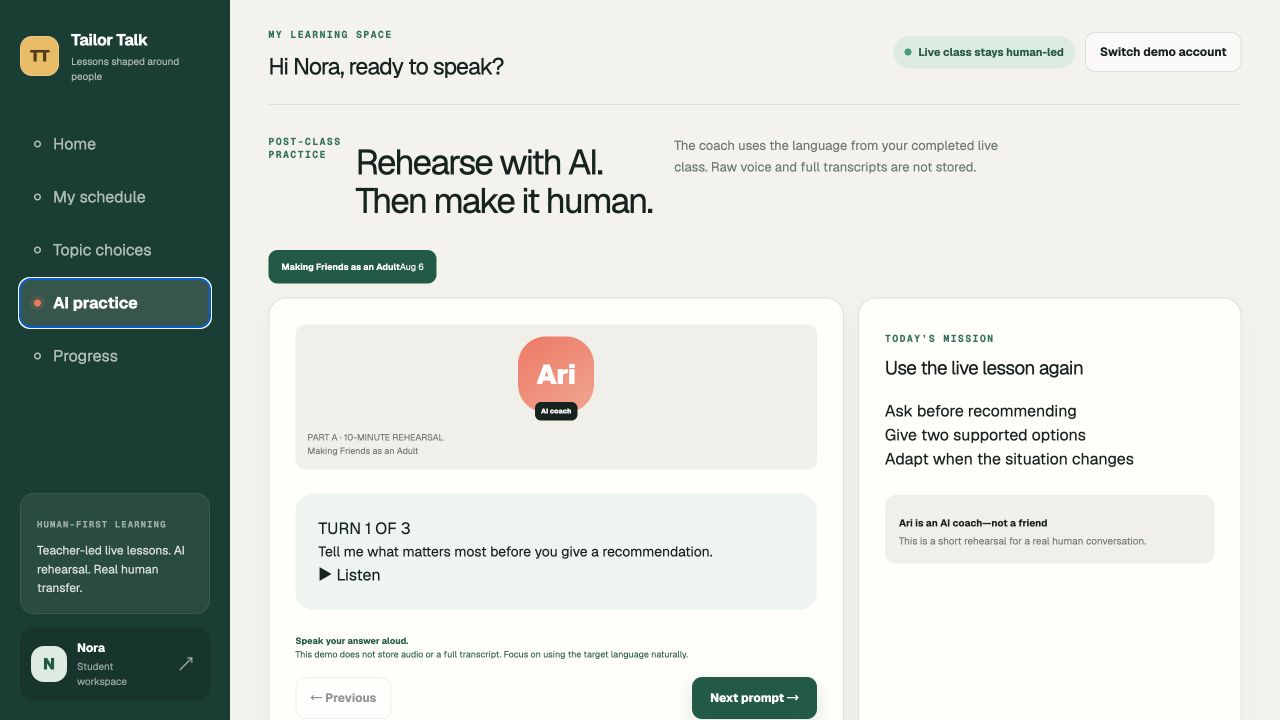
Tailor Talk AI rehearsal screen identifying Ari as an AI coach and limiting practice to three prompts
AI rehearsal · Practice is bounded, lesson-specific, and disclosed as AI.
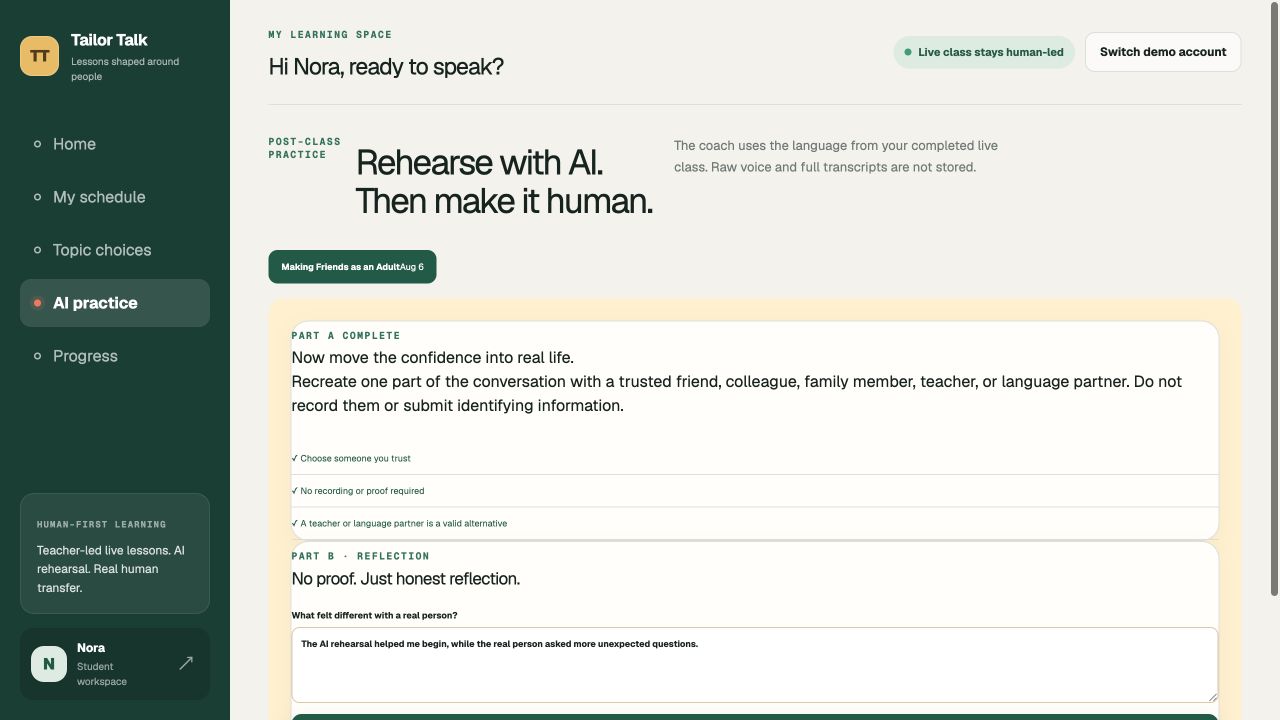
Human-transfer activity asking the student to speak with a trusted person and reflect without submitting proof
Human connection · Practice moves into real life without surveillance.
Teacher approvalAI disclosureHuman transferNo recording or proof

06 / How I worked

I used the prototype to make product judgment visible.

I built Tailor Talk as a solo project and used Codex to rapidly prototype the experience. I owned the problem framing, product requirements, scope, interaction model, UX decisions, and review of the resulting work.

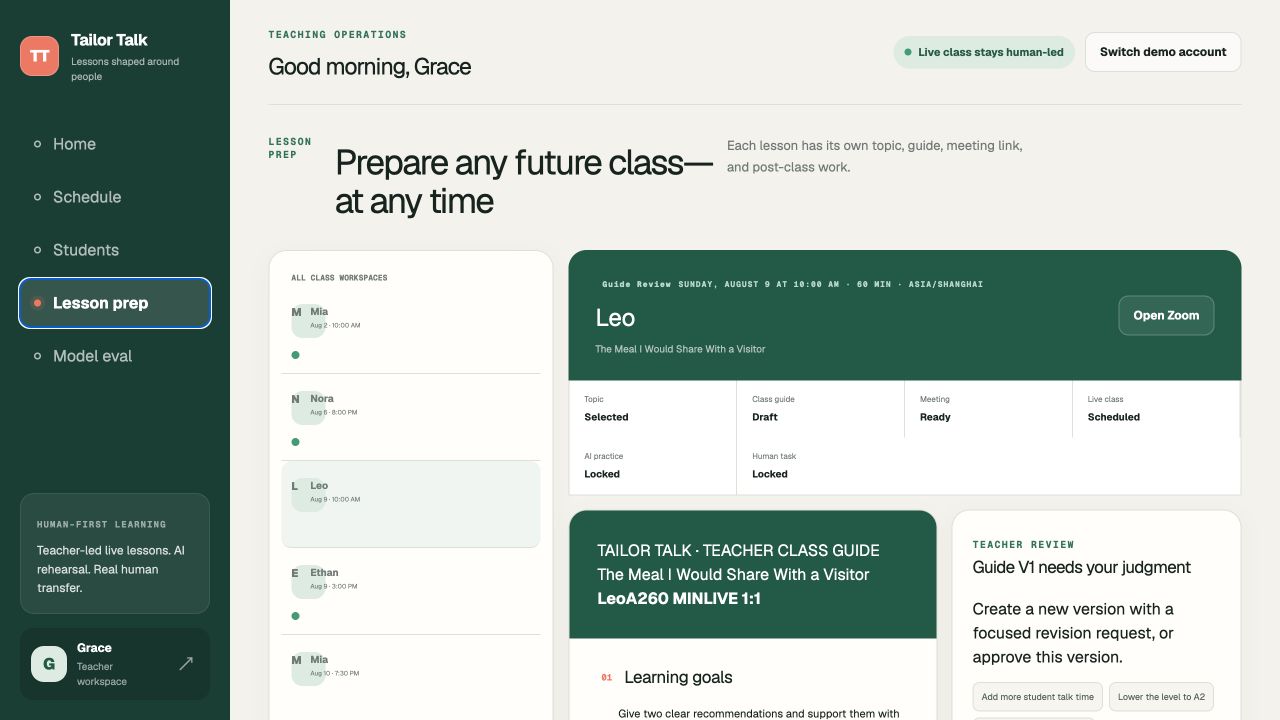
Tailor Talk teacher workspace showing student paths, upcoming lessons, and review states
Functional prototype · One operating view connects the student and teacher sides of the loop.
OwnedProduct judgment

Problem framing, priorities, requirements, interaction model, and UX decisions.

Built withCodex-supported prototyping

Rapid implementation helped me test the full system instead of isolated screens.

Ready to validateEnd-to-end prototype

One connected workflow gives me a concrete experience to test with students and teachers.

07 / Validation

The next step is validation, not expansion.

The prototype shows that the journey can work as one system. It does not show that preparation is faster or that students become more motivated. I would establish a baseline before setting numeric targets.

Teacher primary metric

Median lesson-preparation time

Compare preparation before and with Tailor Talk, then pair the result with teacher-rated usefulness and editing burden.

Student primary metric

Voluntary continuation

Look for an optional next action without a teacher reminder, such as choosing another topic, rehearsing, or returning to a question.

Supporting signals

Agency, relevance, and readiness

Use a short student pulse while keeping offline practice optional, self-reported, and free from recording or proof.

A class can be required. Curiosity can’t be assigned.

Tailor Talk is designed to help create the conditions for curiosity to grow—giving students a voice in what they explore and teachers a faster way to turn that direction into a meaningful lesson. AI supports the journey, but the goal is learning that students choose to continue through real human conversation.